Public Mental Health Working Group

Public Mental Health Working Group

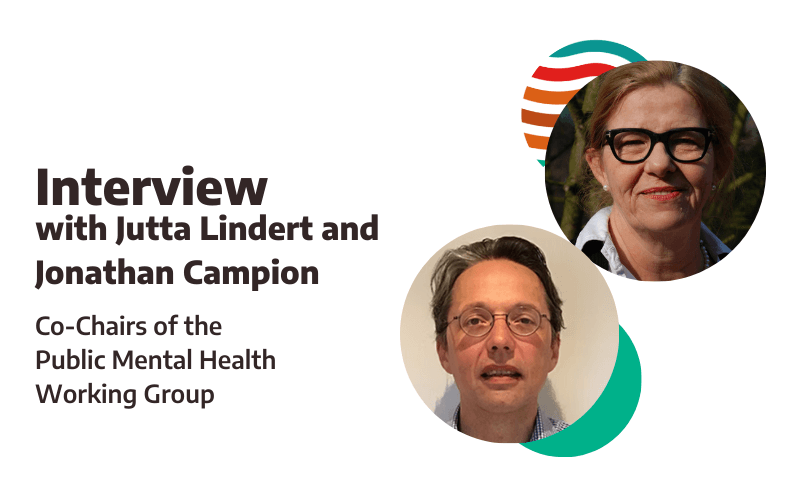
Headshots of two people

Public Mental Health Working Group Co-Chairs Interview: Professor Jutta Lindert and Dr. Jonathan Campion

News

Apr 2, 2025

Public mental health is an increasingly recognized component of public health, vital for improving population well-being and addressing inequalities worldwide. In this interview, we speak with Professor Jutta Lindert and Dr. Jonathan Campion, co-chairs of the World Federation of Public Health Associations’ (WFPHA) Public Mental Health Working Group. 

Jutta and Jonathan share their insights, experiences, and visions for advancing public mental health.

Jonathan and Jutta – please introduce yourselves.

Jonathan Campion: I’m Director of Public Mental Health and Consultant Psychiatrist at South London and Maudsley NHS Foundation Trust in the UK. I am also co-chair of the Public Mental Health Section at the European Psychiatric Association and chair of the Public Mental Health Special Interest Group at the World Psychiatric Association. At the WFPHA, I co-chair the Public Mental Health Working Group with Professor Jutta Lindert. Additionally, I’m an Honorary Professor of Public Mental Health at the University of Cape Town, South Africa.

Jutta Lindert: I am a Professor of Public Health from Germany, specializing in public mental health. I co-chair the Public Mental Health section of the European Public Health Association (EUPHA), which I founded 20 years ago. Back then, public mental health was rarely discussed, but it is now gaining prominence, not just in Europe but globally. I’m thrilled to see the WFPHA embracing this focus because mental health has historically been on the margins of public health. Today, it’s becoming a central concern.

At the WFPHA, I co-chair the Public Mental Health Working Group with Dr. Jonathan Campion. Additionally, I lead a huge European consortium on Youth Mental Health.

How long have you been part of the World Federation of Public Health Associations (WFPHA)?

Jonathan Campion: The WFPHA Public Mental Health Working Group was launched on  2/5/23 during the 17th World Congress on Public Health in Rome. I co-chair this group with Professor Lindert, and other members include Professor Bettina Borisch, Dr. Marta Caminiti, and Professor Paul Unschuld.

Jutta Lindert:  I first observed the WFPHA’s work around 2002 or 2003 but couldn’t actively participate due to other commitments. Over the years, I have appreciated the Federation’s global perspective, essential for understanding and addressing mental health issues in diverse contexts. Now, I am honored to serve as co-chair for the newly founded Public Mental Health Working Group.

What interested you in entering the public health sector?

Jutta Lindert: My primary motivation has always been to improve the health of populations, particularly those living in vulnerable situations. As a researcher, I focus on identifying and mitigating health risks for these groups. It is very important for me to provide reliable data that can inform policies and actions. We need good science to respond to public health needs. Public health combines research and action—using evidence to reduce risks and improve outcomes for those most in need.

Jonathan Campion: I initially trained as a general practitioner and saw firsthand how pervasive mental health issues were, particularly in underserved settings. I also realized how neglected mental health was and how it both drives and is driven by social determinants. This inspired me to train in psychiatry and then focus on broader public mental health policy and practice. The massive implementation gap struck me for the treatment and prevention of mental health conditions and the promotion of mental well-being and resilience. I’m passionate about supporting the scale implementation of evidence-based public mental health interventions to sustainably reduce the burden of mental health conditions and promote well-being, particularly in marginalized communities.

What does public mental health mean to you?

Jonathan Campion: Public mental health involves a population approach to sustainably reduce the burden of mental health conditions and promote population mental wellbeing and resilience through scale implementation of evidence-based public mental health interventions to prevent associated impacts, treat mental health conditions, prevent mental health conditions, and promote mental well-being and resilience.

Despite the availability of such interventions provided by different sectors, there is a massive implementation gap, particularly in low- and middle-income countries —only a minority of those with mental health conditions receive treatment with negligible coverage of interventions to prevent mental health conditions or promote mental well-being and resilience. Addressing this gap prevents population-scale suffering, improves a range of public health relevant outcomes, and reduces associated economic costs. Public mental health approaches represent a key opportunity for public health. 

Jutta Lindert: As WHO rightly emphasizes, there is no health without mental health. Public mental health is about more than just addressing mental disorders, which affect one-third of the global population during their lifetime. Mental health and mental health conditions need to be understood as a continuum. As symptoms can be identified at an early level, it is crucial to better understand the onset and trajectories of mental health conditions. It also involves fostering resilience and reducing environmental and social risks. Strengthening mental health prepares populations for change and transformation, reducing stigma and promoting openness.

What are your goals and visions for the WFPHA Public Mental Health Working Group?

Jutta Lindert: Our primary goal is to disseminate knowledge and foster collaboration across sectors, disciplines, and countries. We aim to deepen understanding through research and share findings via webinars, summer schools, and other platforms. Ultimately, we want to improve mental health literacy and public mental health outcomes worldwide.

My vision is to work on a global model of mental health —and leave more Euro or North American models behind to serve the world’s populations better.

Jonathan Campion: Our Working Group identified the following five key areas:

  1. Support public mental health knowledge, training, and practice.
  2. Integrate public mental health into public health work.
  3. Raise population awareness about mental health and resilience.
  4. Promote collaboration across systems and disciplines.
  5. Support the implementation and research of evidence-based public mental health interventions.

Our actions include fostering cross-sector collaboration, disseminating resources, organizing workshops, and publishing relevant research. For example, on World Mental Health Day 2023, the WFPHA partnered with the World Psychiatric Association and the World Organization of Family Doctors and signed a public mental health statement to advocate for a whole-system approach to address the global public mental health implementation gap. See more here.

Where do you see public mental health in the next five years?

Jutta Lindert: I hope that public health professionals will universally recognize the importance of public mental health in five years. I envision a world where mental health discussions are as normalized as those about physical health, helping to reduce stigma and foster inclusive conversations. Additionally, research on factors contributing to mental health is essential to Public Mental Health. By reducing risk factors, it might be possible to improve mental health.

Jonathan Campion: The next five years present a significant opportunity to address public mental health implementation failure, especially in low- and middle-income countries. We aim to support greater coordination between sectors and evidence-based action to address the public mental health implementation gap across different sectors. By 2030, we hope to have supported measurable progress in closing the public mental health implementation gap and advancing universal health coverage, including for mental health.

What can individuals do to support mental health—for themselves and others?

Jutta Lindert: Supporting others often enhances one’s mental health. Building caring societies and caring relationships is fundamental. We need to be the change we want to see; ethics is crucial to mental health. Alongside well-known strategies like physical activity and sufficient sleep, we need innovative approaches to bridge the gap between mental health needs and available care.

Last comments

Jutta Lindert: It’s crucial to spread mental health awareness across sectors and develop targeted strategies for different age groups. Building resilience and reducing risks can profoundly impact population health. Future research on public mental health should be supported to allow for more evidence-based actions.

How to support others and their own mental health

Jonathan Campion: Mental health affects every family. Promoting literacy about mental health, recognizing early signs of mental health conditions, and understanding preventive strategies are vital. For example, physical activity can effectively address early depression, while smoking cessation has a similar effect on depression as antidepressants. There are also things we can all do to promote our mental well-being. 

Last comments

Jonathan Campion: Mental health intersects with other public health issues, like tobacco use, which disproportionately affects individuals with mental health conditions. Addressing these overlaps can significantly improve population health. Public health practitioners have a particularly important role in understanding what actions are required at different levels to address the implementation failure. This includes informing policymakers about the size of unmet needs and what the most implementable opportunities are to scale up particular interventions that would have maximum population mental health impact as well as a broad range of impacts across other sectors. The WFPHA’s leadership in public mental health is inspiring, and I look forward to working with the WFPHA on this important agenda.

Conclusion

Public mental health is integral to overall health and well-being. As Professors Lindert and Campion highlight, addressing the public mental health implementation gap and fostering collaboration across sectors can sustainably reduce the impact of mental health conditions and promote the population’s mental well-being and resilience. This results in a broad range of relevant public health impacts. The WFPHA Public Mental Health Working Group is poised to play a pivotal role in this global effort.

Working Group Members:

Professor Bettina Borisch: Professor of Public Health at the University of Geneva; CEO of World Federation of Public Health Associations.

Dr Marta Caminiti: Medical Resident in Public Health at University of Perugia, Italy; Co-chair the Public Mental Health Working Group at the World Federation of Public Health Associations.


Dr Jonathan Campion: Director for Public Mental Health and Consultant Psychiatrist at South London and Maudsley NHS Foundation Trust; Co-chair of the Public Mental Health Section at the European Psychiatric Association; Chair of the Public Mental Health Special Interest Group at the World Psychiatric Association; Co-chair the Public Mental Health Working Group at the World Federation of Public Health Associations: Honorary Professor of Public Mental Health at the University of Cape Town, South Africa.

Professor Jutta Lindert: Professor of Public Health at University of Emden (Germany); Co-chair of Public Mental Health Section at the European Public Health Association (EUPHA); Co-chair the Public Mental Health Working Group at the World Federation of Public Health Associations.
Global Public Health Policies for Women, Children, and Youth:

Global Public Health Policies for Women, Children, and Youth:

two babies and woman sitting on sofa while holding baby and watching on tablet

Global Public Health Policies for Women, Children, and Youth: Bridging the Gap

News

Mar 27, 2025

Women, children, and youth face significant health challenges worldwide due to conflict, climate change, and the lingering effects of the COVID-19 pandemic. Despite their heightened needs as a vulnerable population, our research reveals a staggering lack of targeted public health policies to protect them. 

This article synthesizes key findings from a global study of 130 Public Health Associations (PHAs) and outlines actionable steps to drive meaningful change.

Why women, children, and youth health matters in public policy

According to a 2022 United Nations report, disparities persist between low- and middle-income countries and high-income countries, affecting these groups’ access to education, healthcare, and economic stability. Marginalized populations, which include ethnic minorities and those in rural or impoverished urban areas, often experience the most significant barriers to maternal, newborn, child, and adolescent health services.

That’s where public health policies addressing these inequities come in. Public Health Associations (PHAs) advocate for systemic change, working to reduce health disparities and improve community well-being. 

Yet, a significant gap exists. Few PHAs have dedicated policies or workgroups focused on the health of women, children, and youth.

Key findings: a global policy gap

Our study analyzed 130 Public Health Associations (PHAs) across 203 countries, assessing their policies on women, children, and youth. Here’s what we found:

1. Limited policy development

  • Only eight countries (6.2%) and one regional PHA had published policies on women, children, and youth health.
  • Sixty policies were identified globally, with the U.S. (n=20) and Australia (n=18) accounting for 63%.
  • Other countries with policies included Israel (n=8), Spain (n=3), Malaysia (n=4), Canada (n=3), the U.K. (n=1), and Switzerland (n=1).

2. Few dedicated workgroups

  • Just ten PHAs (7.7%) had a women, children, and youth workgroup.
  • Only half had an established policy mechanism (Switzerland, Australia, Malaysia, U.S., and Georgia). 

3. Regional disparities

  • Despite significant health challenges in these regions, no policies were found from South America or Africa.
  • The European Public Health Association (EUPHA) was the only regional body with dedicated policies.

4. Indigenous, rural, and marginalized young people face the greatest risks

  • Indigenous children experience higher infant mortality, malnutrition, and overrepresentation in justice systems.
  • Climate change, vaccine inequity, and mental health crises disproportionately affect young people in low-resource settings. 

The role of the World Federation of Public Health Associations (WFPHA)

The World Federation of Public Health Associations (WFPHA), representing over 5 million public health professionals, has been a leader in advocating for women, children, and youth through its dedicated working group. 

Key policies include:

  • Children and Young People’s Health and Rights
  • Oral Health is an Integral Part of Maternal and Child Health
  • Reducing Maternal Mortality as a Human Right
  • Reducing Maternal Mortality Ration (MMR) in Low- and Middle-Income Countries (LMIC) through Increasing Skilled Birth Attendants
  • A Human Rights Approach to Preventing and Responding to Violence Against Women and Girls

However, most national PHAs lack comparable frameworks. The WFPHA can bridge this gap by:

  • Supporting PHAs in policy adoption
  • Providing training on policy development
  • Supporting regional collaborations
  • Amplifying marginalized voices in decision-making

A Roadmap for Change: 5 Critical Steps

  1. Create Women, Children, and Youth Workgroups – Every PHA should have a dedicated team for women, children, and youth health.
  2. Adopt & adapt WFPHA policies – Global frameworks must be localized to address regional needs.
  3. Center marginalized communities – Prioritize Indigenous, refugee, and rural communities in policy design.
  4. Strengthen healthcare access – Ensure vaccinations, mental health services, sexual health, and maternal care reach those most at risk.
  5. Engage young people in policy-making – Children and young people must co-design programs that affect their lives.

The time to act is now

The United Nations Convention on the Rights of the Child (1989) obligates nations to uphold children’s health and wellbeing. Yet, without stronger policies and investment, millions will continue to fall through the cracks.

Public health leaders, policymakers, and advocates must unite to:

  • Hold governments accountable to international commitments
  • Demand equitable funding for maternal, child, and youth health programs
  • Elevate grassroots solutions from affected communities.

We can build a healthier, more just future for the next generations by addressing these gaps today.


Reference

Robards F, Myers H, Klein Walker D. (2024). Global Public Health Association Policies Related to Women, Children and Youth. Journal of Public Health Policy, 45, 807–813.

Why Inclusion in Science Is Essential for Public Health Progress

Why Inclusion in Science Is Essential for Public Health Progress

grayscale photo of man and woman holding their hands

Why Inclusion in Science Is Essential for Public Health Progress  

News

Mar 5, 2025

Science and public health are at their best when they are inclusive. Diversity in research leads to better outcomes, more innovative solutions, and a deeper understanding of the complex factors that influence health. Yet, recent efforts to dismantle diversity, equity, and inclusion (DEI) initiatives threaten to undo decades of progress. Inclusion isn’t just a moral imperative—it’s a scientific necessity.  

The Value of Diversity in Research

Diverse perspectives drive scientific innovation. When researchers from different backgrounds, genders, and cultures collaborate, they bring unique insights that can lead to breakthroughs in medicine and public health. For example, incorporating sex and gender into study design has improved our understanding of diseases and led to more effective treatments for all populations.  

The Impact of Exclusion on Public Health

Exclusion in science has real-world consequences. When certain groups are underrepresented in research, the resulting data gaps can lead to ineffective or harmful health interventions. For instance, women and minority groups have historically been excluded from clinical trials, leading to treatments that are less effective for them. Inclusive research ensures that public health solutions work for everyone, not just a select few.  

The Role of DEI Initiatives in Science

Diversity, equity, and inclusion initiatives are not just about fairness—they’re about improving the quality of science. These programs create welcoming spaces for underrepresented groups, fund critical research on health disparities, and promote policies that ensure everyone has a seat at the table. Canceling these initiatives undermines the scientific process and perpetuates inequities in health outcomes.  

Why We Must Defend Inclusion

Inclusion is not a luxury—it’s a necessity for advancing public health. By defending DEI initiatives, we advocate for better science, better health outcomes, and a more equitable world. The global research community must stand together to protect these programs and ensure that science remains a force for good.  

Conclusion

Inclusion is the cornerstone of progress in science and public health. We can create a healthier, more just world by embracing diversity and equity. Let’s commit to defending inclusion in science and ensuring that everyone can contribute to and benefit from scientific advancements.  


Why an Assault on Science Anywhere Is a Threat to Public Health Everywhere

Why an Assault on Science Anywhere Is a Threat to Public Health Everywhere

selective focus phot of artificial human skull

Why an Assault on Science Anywhere Is a Threat to Public Health Everywhere

News

Mar 5, 2025

Public health thrives on facts, data, and evidence. From the discovery of vaccines to the development of life-saving treatments, science has been the driving force behind improving individual and community health for centuries. But what happens when science comes under attack? The recent assault on scientific research and institutions threatens not only the progress we’ve made but also our ability to tackle future health challenges.  

The Role of Science in Public Health

Science is the foundation of public health. It provides the evidence to understand diseases, develop interventions, and create policies that save lives. For example, global data collection and exchange have been critical in combating pandemics like COVID-19. Without robust scientific research, we wouldn’t have the tools to track outbreaks, develop vaccines, or implement effective public health measures.  

Why Academic Freedom Matters  

Academic freedom is essential for scientific progress. Researchers must be able to explore new ideas, challenge existing theories, and share their findings without fear of censorship or retribution. This freedom allows the scientific community to evolve, adapt, and respond to emerging health threats. When academic freedom is restricted, it stifles innovation and puts public health at risk.  

The Global Impact of Attacks on Science

An assault on science anywhere is an assault on science everywhere. The global scientific community is interconnected, relying on collaboration and the free exchange of knowledge. When funding for research is cut, when scientists are silenced, or when international partnerships are dismantled, the consequences ripple across borders. This undermines the progress of individual nations and weakens our ability to address global health challenges.  

What Can We Do? 

As members of the public health community, we must stand up for science. This means advocating for increased funding for research, defending academic freedom, and supporting scientists under threat. We must also educate the public about the importance of science-based evidence and its critical role in protecting health.  

Conclusion

Science is not just a tool for understanding the world—it’s a lifeline for public health. By defending science and scientists, we are safeguarding the health and well-being of communities worldwide. Let’s work together to ensure that science continues to thrive for the sake of our present and our future.


Advancing Children and Young People’s Health and Rights

Advancing Children and Young People’s Health and Rights

selective focus photography of girl hugging boy

Advancing Children and Young People’s Health and Rights

News

Mar 3, 2025

Children and young people are the foundation of our future, yet their health and rights remain underprioritized in many parts of the world. The World Federation of Public Health Associations (WFPHA) has taken a significant step forward by developing a Children and Young People’s Health and Rights Policy aimed at reducing inequalities and advocating for the wellbeing of these vulnerable groups. Let’s explore the importance of this policy, the challenges faced, and the actionable steps needed to ensure every child has access to the highest standard of health and rights.  

The Urgent Need for Advocacy in Children’s Health and Rights  

Governments primarily safeguard children’s rights, well-being, and safety. This includes supporting families and communities to address the social determinants of health—factors like poverty, education, and access to healthcare that significantly impact a child’s life trajectory. Despite this, a startling study by Robards, Myers, and Klein Walker (2024) revealed that only eight out of 130 Public Health Associations (PHAs) globally and one Regional PHA have policies specifically addressing women, children, and youth. This gap highlights the urgent need for advocacy and policy development to ensure equitable access to healthcare and integrated support systems.  

Article 24 of the United Nations Convention on the Rights of the Child underscores every child’s right to the highest attainable standard of health. However, the World Health Organization reports that injuries, interpersonal violence, self-harm, and maternal conditions remain the leading causes of death among youth. These statistics underscore the critical need for targeted interventions and policies to protect and promote children’s and young people’s health.  

The WFPHA’s Policy Framework: A Roadmap for Change  

The WFPHA’s Children and Young People’s Health and Rights Policy was developed by a dedicated working group comprising over 50 representatives from Public Health Associations worldwide. This policy emphasizes the importance of integrated care and comprehensive support from birth to 18 years, ensuring optimal health and well-being.

Key recommendations include:  

  1. Equitable Access to Healthcare: Ensuring all children, regardless of background, have access to essential health services.
  2. Rights-Based Approaches: Engaging marginalized groups and recognizing children as active participants in decisions affecting their lives.
  3. Preventive Health Measures: Strengthening primary healthcare and promoting vaccination and early intervention strategies.
  4. Mental Health and Trauma Support: Investing in mental health services and trauma-informed care for young people.

  5. Cultural Respect for Indigenous Children: Addressing inequities by prioritizing self-determination and cultural respect.  

The Role of Public Health Associations in Driving Change  

Public Health Associations (PHAs) play a pivotal role in advancing the health of women, children, and youth. However, the research by Robards et al. (2024) found that only 10 out of 130 PHAs globally have dedicated workgroups focusing on these groups. This lack of focus undermines efforts to achieve the Sustainable Development Goals (SDGs), particularly those related to health equity and gender equality.  

The WFPHA’s policy serves as a valuable tool for advocacy, urging governments and PHAs to prioritize children’s health and rights. By adopting and implementing this policy, countries can reduce inequalities and create a healthier, more equitable future for all.  

Key Recommendations for Governments and PHAs


  1. Develop and Implement Policies: PHAs should create policy statements that advance the health and rights of women, children, and youth. 
  2. Invest in Early Intervention: Governments must allocate resources to early intervention and prevention strategies, particularly for mental health and trauma. 
  3. Promote Community Education: Educate communities about preventive health measures like vaccination and healthy lifestyles. 
  4. Strengthen Integrated Care: Ensure child protection, family support, and welfare services are adequately resourced and integrated. 
  5. Advocate for Equity: Address systemic inequities faced by marginalized groups, including Indigenous children and young people.  

A Collective Responsibility

The health and rights of children and young people are not just a moral imperative but a foundation for sustainable development. The WFPHA’s Children and Young People’s Health and Rights Policy provides a comprehensive framework for action, but its success depends on collective efforts. Governments, PHAs, and communities must work together to ensure every child has the opportunity to thrive.