Looking Back at COP28: Putting Public Health First in Climate Action

Looking Back at COP28: Putting Public Health First in Climate Action

Looking Back at COP28: Putting Public Health First in Climate Action

News

Hannah Marcus

Dec 15, 2023

As COP28 came to a close, it became clearer the importance of focusing on public health to deal effectively with the climate crisis.

The World Federation of Public Health Associations (WFPHA) played an important role at the COP28 Health Pavilion, leading talks to create a sustainable future that prioritizes the well-being of our planet and its people.

Let’s take a quick look back at some important moments from COP28 where key discussions happened about how climate and health are connected.

Embracing a Just Transition: Considering Health in Sustainability

One standout event during COP28 was the discussion on #JustTransition. Diverse voices came together to explore how health considerations could seamlessly fit into our journey toward a sustainable future.

At the event ‘Accelerating a Just Transition for Healthy People and a Healthy Planet,’ Hannah Marcus, Co-Chair of the Environmental Health Working Group at the WFPHA, discussed strategies for a smooth transition to a sustainable future, emphasizing the crucial role of both environmental and public health.

Marcus highlighted the importance of prioritizing public health within the broader context of global climate talks.

Confidence as a Catalyst: Driving Innovation for Change

Amidst the numerous insights shared at COP28, one particularly stood out, resonating with the essence of transformative change. Johan Rockström, Director at Potsdam Institute for Climate Impact Research PIK, a notable voice at the conference, emphasized, “For real innovation to occur, we need to have confidence. Just as the Earth’s systems have tipping points, so do social systems; that is, when enough people have confidence in something new, a tipping point is passed and transformation becomes possible.”

That statement underscores that transformative change becomes achievable when a critical mass believes in something new. It served as a guiding principle, emphasizing confidence’s role in steering innovation towards sustainable solutions.

Insights from the Ground: Hannah Marcus’s Updates

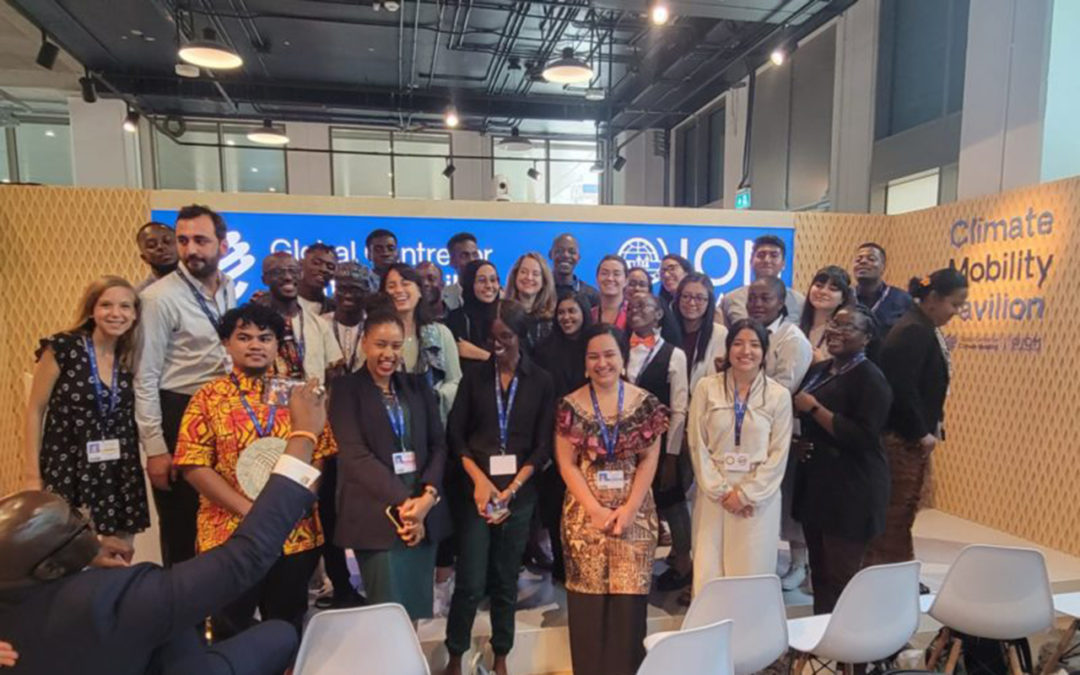
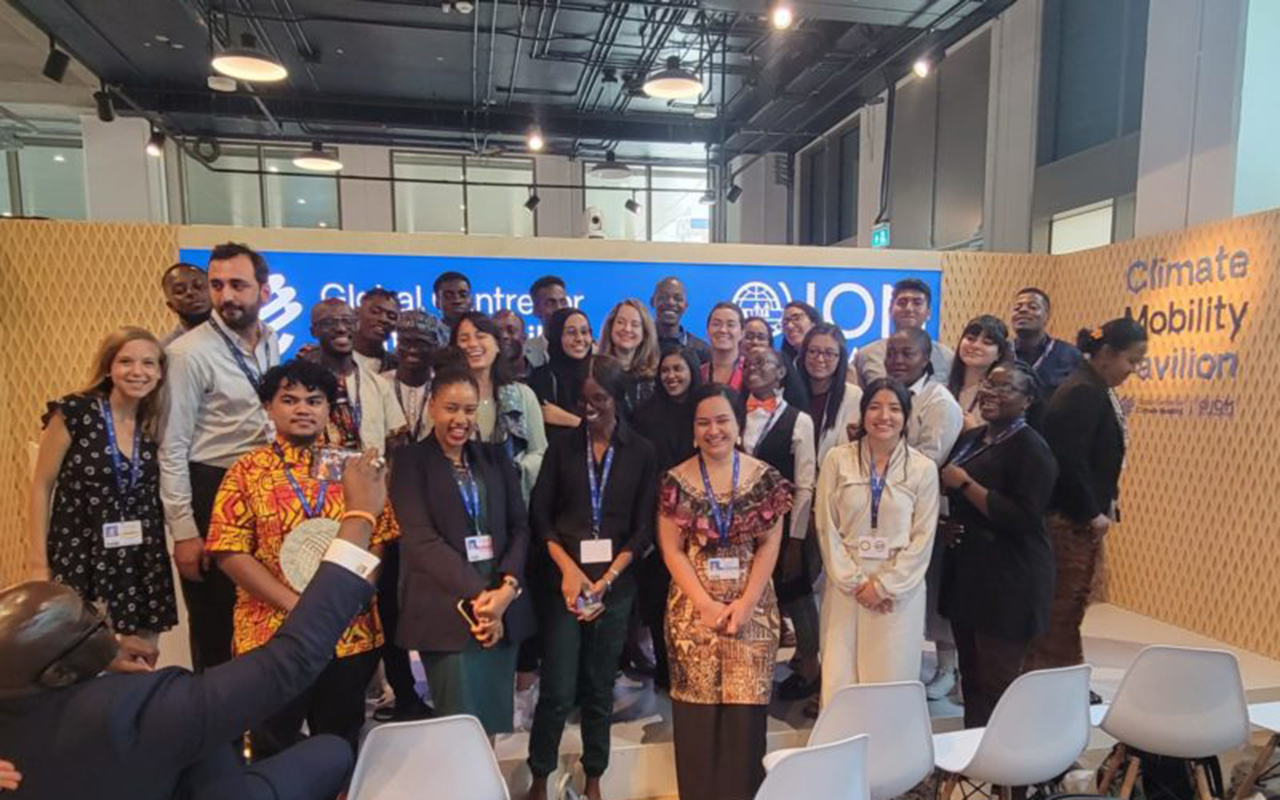
Hannah Marcus kept us in the loop with live updates from COP28. From discussions on prioritizing environmental health to active participation in the Climate Mobility Pavilion youth forum, organized by the International Organization for Migration and the Global Centre for Climate Mobility, she provided real-time insights into the vital conversations shaping the conference.

Networking for Impact: Collaborative Efforts in Focus

Hannah Marcus’s interaction with global health leader DrMariaNeira, WHO Director for Environment, Climate Change, and Health, showcased the collaborative spirit needed to address the intersection of global health and climate action.

WFPHA supports the move away from fossil fuels but urges faster and more ambitious action soon. As we reflect on COP28, the resounding message is clear: public health must play a central role in the global climate agenda.

Join us in revisiting Hannah Marcus’s journey through this pivotal conference, where the well-being of our planet and its people took the spotlight.

Urgent Appeal: WFPHA Addresses WHO Executive Board on Health Conditions in Occupied Palestinian Territory

Urgent Appeal: WFPHA Addresses WHO Executive Board on Health Conditions in Occupied Palestinian Territory

Urgent Appeal: WFPHA Addresses WHO Executive Board on Health Conditions in Occupied Palestinian Territory

News

Dec 9, 2023

The World Federation of Public Health Associations (WFPHA) congratulates the initiative of the World Health Organization Executive Board to hold a Special Session on the health conditions in the occupied Palestinian territory. As an entity that represents 130 national associations and more than 5 million health practitioners around the globe, the WFPHA joins with UN and WHO leaders’ voices expresses deep concerns about the situation, echoing the voices of UN and WHO leaders.

Urgently calling for an immediate ceasefire between Israel and Hamas militants, the WFPHA emphasizes the need for a peace process to safeguard the well-being of health professionals and the civilian population in the region.

Strengthening Global Public Health Resilience: WHO Roadmap & Action Plan for the Public Health and Emergency Workforce

Strengthening Global Public Health Resilience: WHO Roadmap & Action Plan for the Public Health and Emergency Workforce

Strengthening Global Public Health Resilience: WHO Roadmap & Action Plan for the Public Health and Emergency Workforce

News

Dec 4, 2023

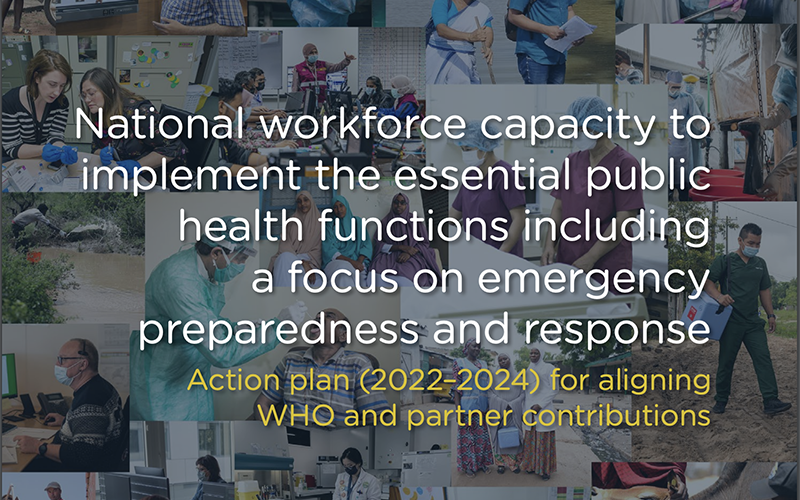
The recent challenges posed by many emergencies, from natural and man-made disasters to the COVID-19 pandemic, underscore the critical importance of a robust and resilient public health workforce. In response to the pressing need for a coordinated and skilled workforce, the World Health Organization (WHO) has unveiled a comprehensive roadmap and action plan for training and securing the Public Health and Emergency Workforce. This initiative revisits the Essential Public Health Functions (EPHFs),  addresses the structure of the global public health workforce, and emphasizes the need for an appropriately trained and resilient public health workforce in addressing public health needs, those considered core public health activities a critical to the health of everyone but less obvious and visible.

Conceptualization of the Roadmap:

The Roadmap’s genesis can be traced back to the G20 Italy Declaration in October 2021, followed by an expert consultation in January 2022. The Roadmap and Action Plan were officially published in May 2022, with the establishment of the Roadmap Taskforce, coinciding with other global initiatives and meetings such as the G7 Berlin Pact for Readiness, and the launch of the Pandemic Fund in November 2022. Noteworthy events in 2023 include the G7 Japan Partnership for Global Infrastructure and Investment and the 3rd Roadmap Taskforce Steering Committee Meeting in July.

Vision & Purpose:

The Roadmap vision is to strengthen the public health workforce in every country, and includes three Action Areas (AAs):

AA1: Operationalizing the Essential Public Health Functions (EPHFs) – an integrated and comprehensive approach to public health

  • Identifying and defining the EPHFs & services and their enablers
  • Updating and expanding the EPHFs, and adding subfunctions
  • This strategic review was achieved through a worldwide expert consultation process.

AA2: Competency and outcomes framework towards the delivery of the Essential Public Health Functions

  • Identifying the tasks the public health workforce performs, both regularly as all or part of usual work, and during emergencies
  • Mapping the academic and practical training the workforce needs to accomplish these tasks
  • Developing a framework for competency-based education.

There are two major sections about competence, personal and practical:

  1. Competencies for individual public health and emergency workers towards the EPHFs; and
  2. Practice activities towards Essential Public Health Functions (EPHFs)

This was achieved through a major systematic literature review and content analysis mapping process, refined through an expert review of international experts. Future work involves strengthening institutional processes for updating curricula to ensure appropriate workforce capacities.

AA3: Technical guidance for mapping and measurement of occupations that contribute to the delivery of the essential public health functions including emergency preparedness and response

  • Mapping & Measurement of Occupations by developing a standardized approach for occupation mapping.
  • Discussions about the International Standard Classification of Occupations (ISCO) revisions.

Again, this was achieved through an international consultation process. The mapping tools and processes have been piloted in seven countries.

Way Forward:

The roadmap sets clearly defined targets for the five-year period from 2022 to 2027, emphasizing a systematic and progressive approach to achieving its goals.

WHO is seeking countries to use at least one of these tools, hoping to enroll 100 before July 2024. The process for becoming involved is not complex and can be found on the Roadmap website (address below).

Reflection & Summary:

In conclusion, the Roadmap responds to the pressing need for a skilled public health workforce, highlighted by the recent pandemic and other recent emergencies.

By paving the way for competent personnel adapted to individual contexts, it aims to create resilient health systems and foster public trust. For those interested in further resources the relevant documents are available in draft form, the final versions to be available early in 2024.

Urgent Global Health Appeal to COP28: Accelerate Fossil Fuel Phase-Out for Public Well-being

Urgent Global Health Appeal to COP28: Accelerate Fossil Fuel Phase-Out for Public Well-being

Urgent Global Health Appeal to COP28: Accelerate Fossil Fuel Phase-Out for Public Well-being

News

Nov 1, 2023

On the occasion of the first ever health day at COP, an open letter from health professionals around the world urges the COP28 presidency and world leadership for a commitment to an expedited phase-out of fossil fuels and an investment in a renewable energy transition to ensure the health of all.

#FossilFree4Health #COP28HealthLetter


The letter, supported by organizations representing 46.3 million health professionals, emphasizes the urgent need to transition away from fossil fuels, invest in clean energy technology, and reduce air pollution to protect public health.


The climate crisis is not just an environmental issue; it’s a public health crisis that threatens the fundamentals of human life. The World Health Organization recognizes climate change as the greatest threat to global health in the 21st century, emphasizing the inseparable connection between a safe and stable climate and achieving health and well-being for all. Communities, health workers, and health systems worldwide are already experiencing the severe impacts of climate change, with extreme weather events, food and water insecurity, and displacement becoming more frequent and devastating.


One of the major drivers of climate change and air pollution is the burning of fossil fuels. Fossil fuel combustion, particularly diesel and coal, is responsible for millions of deaths annually due to air pollution. Despite its well-documented consequences, 99% of the world’s population lives in areas where air quality breaches the World Health Organization’s guidelines, and air pollution’s economic costs are staggering, totaling over $8.1 trillion in 2019.


Beyond air pollution, toxic discharges from downstream fossil fuel industries like petrochemicals, plastics, and pesticides also pose severe health and environmental risks. Communities near these facilities suffer from adverse health impacts, including cancer, endocrine disorders, and birth defects. 


The key highlights of the letter include the call to end our dependence on fossil fuels to safeguard future generations and save lives, the importance of a rapid transition to clean energy for clean air, water, and a healthy environment, and the rejection of unreliable solutions like Carbon Capture and Storage in favor of renewable energy. It also underscores the need for a just energy transition that prioritizes health and community well-being, ending fossil fuel subsidies, and preventing the fossil fuel industry from influencing climate negotiations. It categorically states that without ambitious climate action, healthcare systems and workers will bear insurmountable burdens, undermining prospects for a safe, fair, and just future in the face of climate change.


Physicians under bombardment: In solidarity with frontline health heroes and heroines  

Physicians under bombardment: In solidarity with frontline health heroes and heroines  

Physicians under bombardment: In solidarity with frontline health heroes and heroines  

News

Oct 31, 2023

By: Dr. Duha Shellah, Medical & Health Sciences Division, Palestine Academy for Science & Technology

As a physician, Palestinian and voice of physicians in Palestine and the eastern Mediterranean region (EMR). I am sending out this call for solidarity, to raise the voices of the health workforce in Gaza. The Health Workforce is under an unimaginable workload because of the dire situation wrought by the war in the Gaza Strip. The war has entered its fourth week of continuous horrific attacks which led to extensive destruction of all forms of life in Gaza, civil and health infrastructure were widely destroyed which is alarming for a collapse of the health system in Gaza. The number of casualties received in hospitals is huge. Some of my colleagues have not gotten any rest been home or even seen their families since the beginning of the war. Moreover, some were surprised to see their family members among the casualties and martyrs.  With the tragic loss of 73 health personnel who have been killed, 11 were killed on duty, and more than 100 have been injured, and 26 ambulances are out of service, the health system is taking its last breath, and the result will be havoc. 

Contacting friend physicians,  nurses, midwives, and social workers is different now. It takes days for them to respond. where in two or three minutes of rest, they text us “We are fine”. Most International humanitarian agencies announced the difficulty in contacting their staff on the ground in Gaza. With no electricity or fuel stocks, the situation is devastating. The lack of beds in wards and emergency rooms with a shortage of medical supplies is indeed overwhelming, to the system and staff.  No form of health services is available except life-saving services.


With the collapse of 25 hospitals and most of the primary healthcare facilities in Gaza, the health situation is catastrophic. The vulnerable groups are with no access to essential health services. The shutdown of backup generators in hospitals would place the lives of thousands of patients at risk.  civilians in Gaza are at risk of infectious diseases due to lack of personal hygiene and clean water, besides, overcrowding in shelters. Many children have stopped regular immunization, and their right to grow in a safe and clean environment and to develop physically and mentally has been retracted from them. 

The 16-year blockade on Gaza has fragilized the health system, with physician and specialty shortages and a lack of medical equipment and medications. Those years of socioeconomic decline political instability and conflict have weakened the public health infrastructure, leaving the strip with limited access to clean water, sanitation, and hygiene. The ongoing war on Gaza has amplified what the Palestinians and the health system have been facing. The deprivation of clean water, food, fuel, and electricity is causing a humanitarian catastrophe. Keep in mind the environmental hazards of the continuous heavy bombardment and extensive destruction of the sewage system. 

I call for solidarity with physicians, public health specialists, health workers, and humanitarian workers, all those working on the frontlines trying to save lives, and most importantly save the Palestinian identity in the Gaza Strip. International Humanitarian law must be abided, indiscriminate violence and collective punishment should end and an immediate ceasefire is a must. All lives matter, all lives.  Physicians and health workers have to stand for each other in times of war and conflict, it is a moral duty to stand out for those on the frontlines of danger, who are working under bombardment, and who have been oppressed for years.